Proyecto H, through its residency program Proyecto T, is pleased to present the work of artist Javier Sánchez in the exhibition Observation and Thought, on view from October 20 to December 15, 2022.
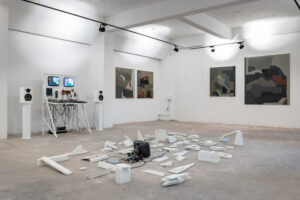
Javier Sánchez is an artist whose practice centers on sound research and experimentation through visual arts. His work draws from processes such as the hacking of obsolete technologies, experimentation with electricity, and the merging of these mediums with the plastic arts. The deconstruction of ideas, images, and materials plays a fundamental role in his work as a way to develop thematic axes.
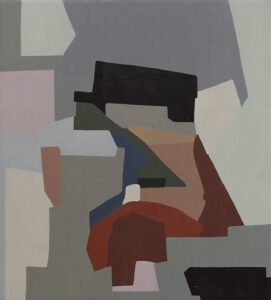
Observation and Thought consists of a series of oil paintings on canvas, or Non-objective Paintings (2022), which result from the use of black, white, and orange, and the multiple mixtures and combinations that can emerge from these colors. The shapes deliberately avoid any representation of the natural world and reflect the artist’s introspective observation.
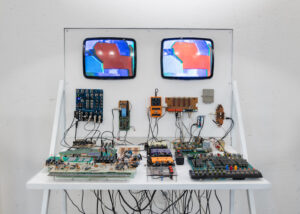
The installation Timeless Obsolescence (2022) is a sound piece that unifies the technological aspect with the rest of the exhibition. This interactive work projects images of the same abstract shapes found in the paintings onto screens, allowing the viewer to manipulate them through a control panel. Without instructions, clues, or sequence, the user can modify colors and textures through play—by turning, pressing, touching, and connecting the various buttons and keyboards presented. These visual transformations are accompanied by random sounds, also triggered by the control panel, and can only be activated through the same tactile and intuitive engagement.
Javier Sánchez has focused his artistic practice on the phenomenology of essential content, on the organic manifestations that arise between emitter and receiver—without reproducing the appearance of objects or seeking representation of the natural world. Whether through color and shape on canvas, their translation to a screen, the pathways of circuitry and their activations, irregular representational fields, or the ordering of fragments arranged in time for observation, Sánchez’s work invites a deeper inquiry. His constructions, transmissions, and alignments provoke questions about how meaning is represented—beyond what is visibly evident—through forms of erosion that are as mechanical as they are metaphysical. Between saying, doing, and offering, between the pathways and the transitions from one to another.
I think, for instance, of the equivalences between his installations and the mechanisms that drive them: they might be tracks and the train that runs on them; or a pulley system lifting and lowering containers and contents; or an anthropomorphic device that mimics a cymbal-clapping bear—alternating between tension, restraint, and release. These actions, and their programmed repetition, point to a kind of absurdity in the pursuit of higher efficiency, like that expected from a vending machine or an ATM that reads your card and lists your balances and debts, or an algorithm that—depending on what you say—decides what comes first and what follows. I imagine these as devices activating other devices, as stimuli, embedded in a culture trained to follow a succession of actions to achieve a goal. The question then is: To what extent do mechanisms become stimuli? The objective becomes immanence. How do we represent or describe these stimuli? How do we give them a place?
I return to immanence—that electrified field that can be felt, and sometimes seen or heard—comparable to a stormy sky with its thunder and lightning. This energy is inferred and translated through more or less conventional means. I mention this in light of the formal outcomes in Sánchez’s work: his commitment to exploring subtler materials—sonic, systemic, electronic—has led him to painting, approached from a learned notion that layers meaning through saturation and superposition. These shapes—irregular, asymmetric, and incomplete—may appear arbitrary but are not. They either mimic or embody fields—particles or frequencies—and how they overlap through time, in the succession of moments. Perhaps it is from here, from the evidence of the intangible, that we arrive at the paradox of trying to catch lightning in our hand: a presence that recurs and returns, manifesting itself materially and simultaneously as a ghostly trace—like the flickering image produced by cathode ray bombardment on a screen.
To see becomes to see beyond, to see through—trapped in the illusion that what we see is real, an illusion mechanically reproduced through repetition and succession of moments we once believed to be true.
—Ricardo Pohlenz