
Earth alone. Earth.
Earth for the trembling tablecloths,
for the cloud’s vicious pupil,
for the fresh wounds and the damp thought.
Earth for all that flees from the Earth.
—Federico García Lorca
And the clearer it becomes to us that such a scar is no longer a wound, but rather flesh upon our very own flesh that will never regenerate—and where I say flesh I might as well say memory or remembrance—the more inclined we will be toward what one might call historical well-being, whether emotional or rational.
—David Miklos
Paloma de la Cruz (Málaga, Spain, 1991) works with ceramics as an exploration of the body, the earth, and the territory: a symbolic and political act to connect “body with place.” Clay—vital and ancestral matter—becomes body, memory, and landscape; a vessel for the intimate and the collective. In her works, clay not only recalls its earthly origin but also acts as refuge, shield, and perhaps, prison.

The pieces—clay blankets, porous lattices, fragmentary assemblages—transform material into an emotional archive. In them, ceramics become an extension of the body: a fabric of memory that links the domestic with the ritual, the personal with the historical. Her forms, inspired by Andalusian lace, textiles, and tiles, are not isolated ornaments but shared cultural signs; references to the feminine, the ancestral, the familial. By rescuing specific motifs of strong symbolic charge—such as the weave of an orange nightgown sewn by her grandmother, or floral elements taken from clothes, curtains, and tablecloths she has found—the artist articulates a sculptural language that builds bridges to that primordial essence that connects us collectively. What makes us human? What indissoluble bond exists between body and earth?

On a formal level, De la Cruz revisits these personal motifs to speak of skin-flesh as a resilient and permeable frontier, strong yet delicate, functioning at once as armor and home. An imperfect skin, composed of interconnected pieces, like someone attempting to reorder the stories inherited and resignify the identity baggage imposed upon them. It is no coincidence that her work resonates with the figure of Quetzalcóatl, the feathered serpent: deity of Mexica cosmogony symbolizing the union of earth and sky. The transformative power of shedding skin as a strategy of resilience, protection, and vulnerability echoes in her scale-armors, in her handwoven blankets, or in her permeable structures that reveal what is absent. Pieces that generate other pieces to invade or inhabit spaces, blending tradition with personal or local symbolism, addressing themes that transcend individual identity to touch what is essentially human.
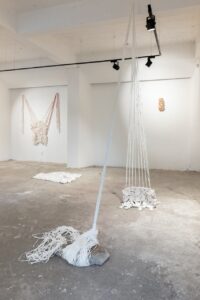
These are not puzzles, for they do not fit together perfectly: their assemblage is precise, yet not exact. Careful yet firm, like one who stitches a wound without concealing it, with the purpose of healing.
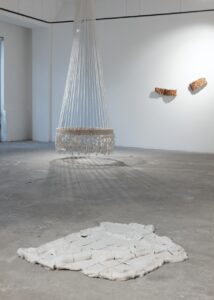
Each work in this exhibition explores the connection between ornamentation and the memory of the familial domestic. The reference to “the Andalusian” is not mere decorative backdrop, but a living body charged with cultural and emotional meaning—personal yet recognizable across other cultures. From the use of local floral and decorative patterns to the allusion to Andalusian tilework—known in Mexico as azulejos and part of our culture since colonial times—De la Cruz intertwines the intimate and the common as elements of an identity in constant construction and transformation.
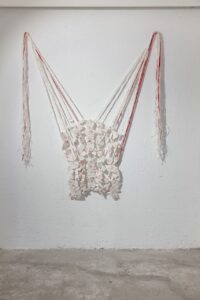
Threading fragments to recompose narratives, sustain memory, and build bridges between: the ancestral and the contemporary, strength and vulnerability, the intimate and the shared, absence and permanence. Reordering as a poetic and political act to heal without erasing scars, like a visible and porous fabric that honors present absences.

Between the textile and the sculptural, the feminine and the primitive, Paloma de la Cruz constructs landscapes where body, territory, and memory are interwoven as a living, porous, and resilient testimony. In every fragment and every union—robust and delicate—resides the latent possibility of transformation, even from stillness, solidity, or apparent suspension.
Tania Ragasol