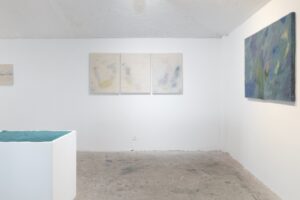
Flatlands
José Romussi
Flatlands emerged during the residency at Proyecto H as a means to continue developing the technique that José Romussi refers to as brushing paintings: a way of working the surface that he directly associates with the way memory operates. Memories do not disappear entirely; rather, they fade and become blurred. What remains are images that are still there, even if they are no longer sharp or clearly defined.
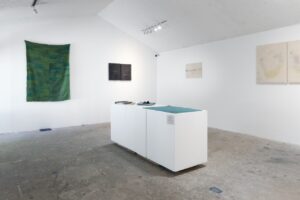
In Flatlands, Romussi is no longer concerned with experiential memory, but with optical memory: the kind that is constructed from images we all carry in our retinas. A sunset, a sunrise, the sky, a tree, rain, a forest, a plant. Landscapes we recognize without having necessarily lived them ourselves, yet which are associated with moments, sensations, or emotional states.
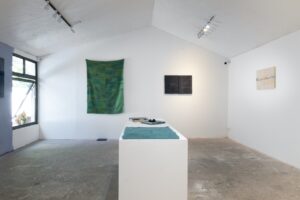
The horizon appears as a line that organizes the image, as a point of support from which everything begins. From there, José constructs monochromatic landscapes in which color evokes and suggests; in this intersection between image and tone, memory is activated—a place, a time, a recollection.
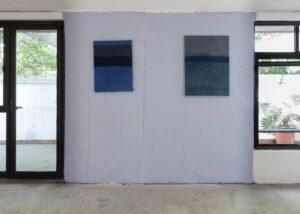
Flatlands also incorporates new processes in the creation of the final works. José experiments with dyeing his own materials, using natural pigments to achieve greater precision in the colors and atmospheres he seeks to convey. By adding layers of process, the work is enriched, but the relationship with it is also transformed. Taking the time to create the materials, to move through each stage, makes the work more human: a form of resistance against the logic of rapid, mass production that dominates the present.