
Poesía Quimera
Every painting is a surface where something is written.
There is no such thing as a truly original work—only variations of collective arrangements made up of values, ideas, emotions, and sensations that circulate within the imagination of a time and place. The lack of originality doesn’t mean nothing gets written; rather, the act of writing or marking a surface becomes a kind of rewriting, a performance, a unique way in which the artist engages with materials and the world.
Sometimes, this kind of inscription can be powerful enough to transform it’s starting point. A classic example is Duchamp’s Fountain (1917)—a urinal taken from a factory and placed in an exhibition space, which completely changed how we understand art. It showed that an artwork doesn’t have to be something handmade—it can also be an idea or a provocation.
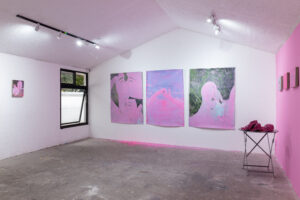
Poesía Quimera began as a conversation between the artist and Alejandra Tena, who has worked with him on several occasions and now curates this exhibition in collaboration with Proyecto H. Together, they decided to focus the show on the artist’s archive of visual “inscriptions” he has collected while walking through different cities in Mexico. However, this is not about turning street images into gallery-ready objects (like the ready-made). Instead, it explores how everyday life and advertising imagery overlap.
Through walking, wandering, and recording, Turón collects advertising forms—framing, close-ups, colour harmony, body language, seduction, and the promise of an ideal—and mixes them with altered phrases that reflect shared emotional experiences. Blending surrealist disruption with situationist psychogeography, he assembles these elements into something new. The transformation lies in how desire is communicated—through emotionally charged sentences combined with the visual language of advertising. Whether the focus is on the image or the text, these paintings show that just as there are no original artworks, there are no original feelings either.
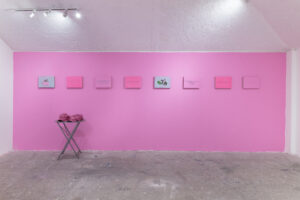
The background is a poetic pink—a colour that holds up the fantasy of the ideal self, of all the things we believe to be personal: what makes us laugh, cry, hurt, or shout. It’s a pink tied to sentimental education, disguising learned feelings as natural ones—feelings shaped by teams of all kinds, whether in families, films, art, or marketing agencies.
While these institutions help shape and spread the ghosts, ideals, and symbols that drive our desires, focusing on the “chimera” allows us to avoid judging these processes morally. Instead, we can pause and look at the hidden seams and joints—the glue and stitching that hold these constructed images together and makes them feel solid and complete.
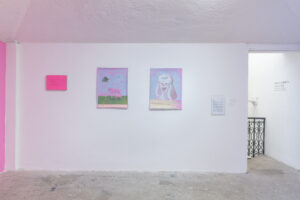
Additionally, this poetry has a sense of humour. The “chimera” isn’t a disappointment or a reason to despair in some “to be or not to be” dilemma. On the contrary—we laugh together at our own monstrousness. Through bittersweet moments, personal stories, and laughter that can be awkward but sincere, we come to recognise that even the most clichéd phrase might express something deeply personal—perhaps even something we’ve already lived through and moved beyond.
Sandra Sánchez, Spring 2025